 LTG
LTG2024-07-17
Greenpeace supports Rail Baltica: it will solve transport and pollution problems

In July, the Greenpeace published a study entitled “Connection Failed”, analysing existing and potential direct rail and air transport connections between major European cities. Noting that rail transport significantly reduces CO2 emissions, Greenpeace called on the European Union (EU) and national governments to invest more in European rail infrastructure.
According to Herwig Schuster, a representative of the organisation, Rail Baltica is a major railway project in Europe, which will not only solve the issues of communication and access to the common European rail network, but also pollution problems.
Encourages taking trains instead of flying
In a newly published study, Greenpeace analysed 990 routes between 45 major cities in Europe, comparing the number of existing and potential direct train connections with the number of direct flight options.
Only 12%, or 114, routes in Europe are directly connected by train, compared to 69% by plane. So, air travellers in Europe have six times as many direct connections to choose from.
New infrastructure lines, such as Rail Baltica, which would connect cities in the region, would address the identified shortage of routes and allow carriers to offer more varied and faster routes across Europe and a more sustainable way of travelling.
The analysis identified five European cities with the best direct train connections: Vienna (17 connections), Munich (15), Berlin (14), Zurich (13), and Paris (13). The most negative assessment was given to Athens, Lisbon, Pristina, Sarajevo, Skopje, and Tallinn. None of these cities have a direct train connection to other European cities. Riga is connected to Vilnius, and Warsaw is accessible from Vilnius as well.
Greenpeace concludes that “European cities are still far better connected by air than by rail, which encourages people to fly rather than take trains, despite aviation’s harmful impact on the climate”.
Rail Baltica is an important part of the European map
Rail Baltica, which is mentioned in Greenpeace’s analysis, plays an important role in improving connectivity in Europe.
Herwig Schuster, transport campaigner for Greenpeace Central and Eastern Europe, put Rail Baltica on a par with other major European infrastructure projects, such as the Brenner Tunnel in Austria, which connects Germany and Italy, and the Fehmarnbelt tunnel between Denmark and Germany.
“Given the state of the Baltic rail system and the 1520 mm track gauge, Rail Baltica is the best solution for the Baltic States,” said H. Schuster. “It is not only important to invest in major new projects, but also to maintain and upgrade the railway lines that serve the whole country and the regions. If people do not have access to the country’s main railway stations by public transport, many of them will choose to drive instead of taking the train, because their dependence on cars will remain.”
Greenpeace’s analysis shows that the Baltic States are virtually unconnected to the European rail network, so EU investment in the Rail Baltica project is being put to very good use.
The importance of railways is growing
The European-standard railway line will increase the Baltic States’ connection with other European countries. In addition, Rail Baltica will contribute to the objectives of the European Green Deal.
“By developing Rail Baltica, the Baltic States are contributing to leadership at European level. The developed Western world is investing in railway construction, electrification of networks, and launching new development projects. Trends show that attention to this mode of transport is growing and that in the future rail transport will become even more important,” said Vytis Žalimas, CEO at LTG Infra, the company implementing Rail Baltica.
According to Greenpeace, aviation is one of the world’s most climate-damaging industries. Electrified rail emits at least ten times less CO2 than cars or planes. This dramatic difference in emissions is particularly significant for achieving climate change mitigation goals.
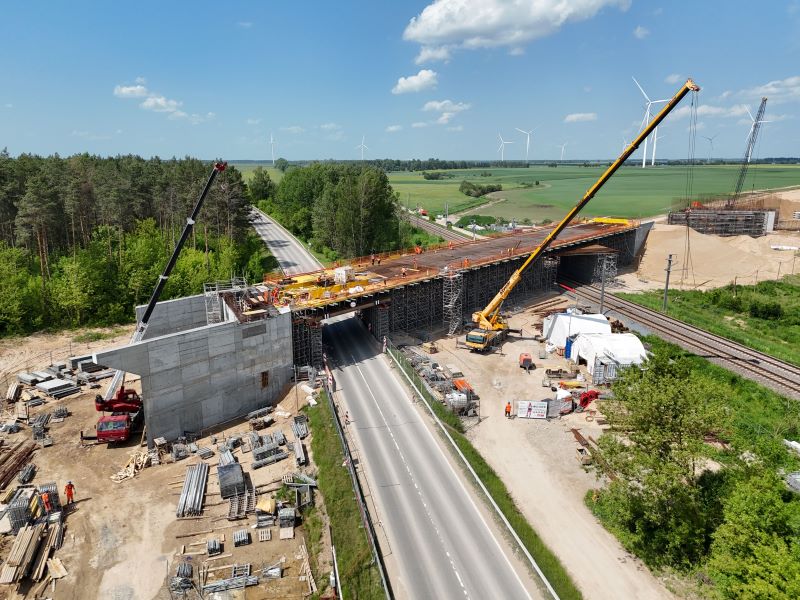
Rail Baltica is the largest railway infrastructure project in the history of the Baltic States, which will see the construction of an electrified European-standard double-track railway connecting Warsaw, Kaunas, Vilnius, Panevėžys, Riga, Pärnu, and Tallinn. The total length of the Rail Baltica railway line in the Baltic States is 870 km: 392 km in Lithuania, 265 km in Latvia, and 213 km in Estonia.